SaaS! IaaS! DBaaS? — Part 2: Key Players Deep Dive — Who Dominates the Cloud?
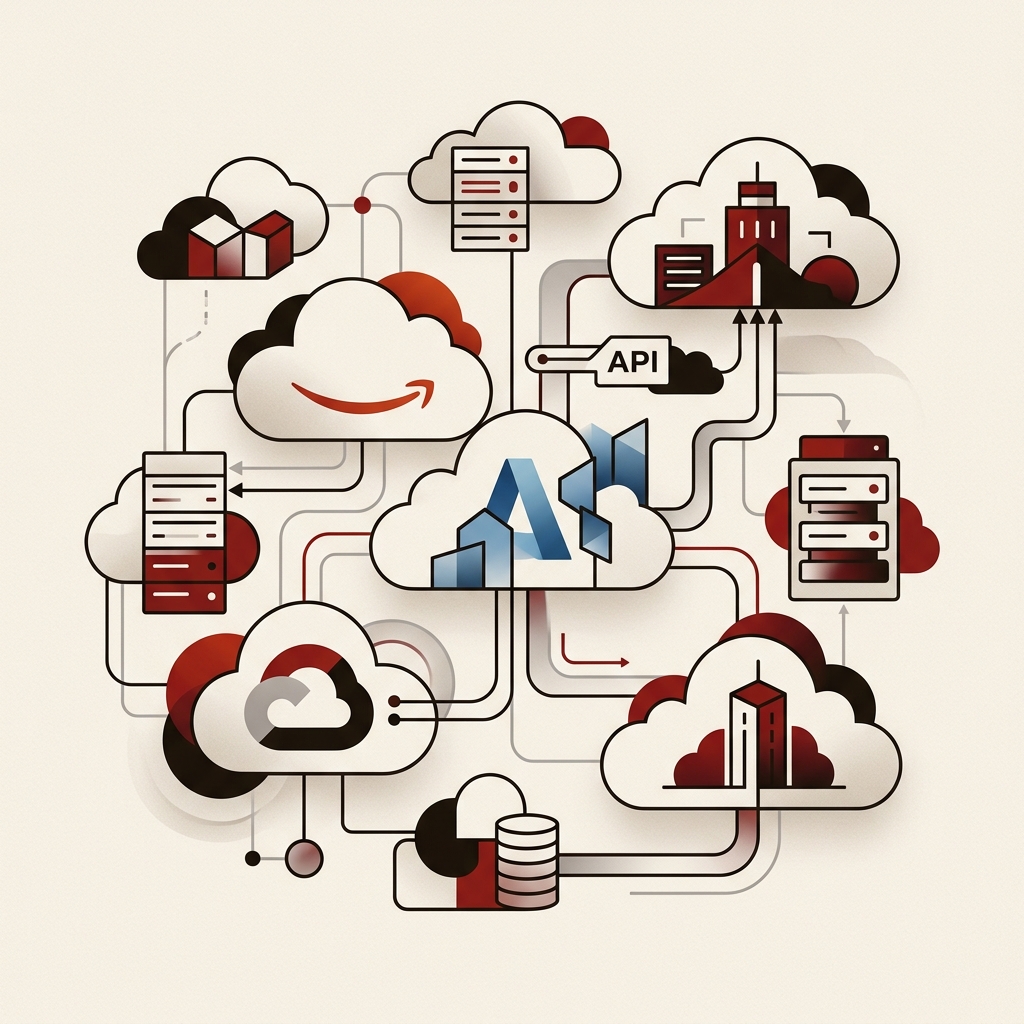
In 2026, SaaS competition is shifting from isolated point tools to broad enterprise platforms — Salesforce, Microsoft 365, and ServiceNow now compete on workflow ownership and ecosystem lock-in rather than features alone. IaaS remains a hyperscaler race: AWS wins on service breadth and maturity, Azure on Microsoft enterprise integration, and GCP on AI and data analytics. DBaaS selection is less a database-feature comparison and more an operating-model and infrastructure-fit decision — Amazon RDS, Cloud Spanner, and MongoDB Atlas each have distinct strengths tied to specific workload contexts. AI is a cross-cutting pressure across all three layers, but real product capability must be separated from marketing language. Which vendor wins for your team depends on existing ecosystem, budget, data shape, and operational maturity.
Series outline
- Part 1 — Cloud Service Models and the 2026 Market Landscape
- Part 2 — Key Players Deep Dive — Who Dominates the Cloud? (this post)
- Part 3 — Selection Guide: Which Cloud Model Is Right for You? (upcoming)
Table of Contents
- SaaS: The Platform Wars
- IaaS: The Hyperscaler Race
- DBaaS: The Three-Way Battle
- Key Competitive Shifts in 2026
- Wrapping Up — What's Next in Part 3
1. SaaS: The Platform Wars
In 2026, SaaS has moved past a tool competition and into a platform war. The market that once fragmented across hundreds of point solutions is now consolidating around a small number of mega-platforms. Three forces are driving this: enterprise pressure to reduce vendor sprawl (cost control, security governance), AI features becoming native to platforms rather than add-ons, and procurement teams preferring "one vendor, company-wide deployment."
The center of power in SaaS competition is workflow ownership. The deeper a platform embeds itself into employees' daily work, the higher the switching cost — and the more defensible the position.
1-1. Salesforce — The Living Legend of SaaS
Salesforce introduced the concept of cloud CRM in 1999 and still holds the top position in 2026.
| Metric | Figure |
|---|---|
| FY2026 Revenue | $41.5B (+9.6% YoY) |
| Market Cap | ~$191B |
| Global CRM Market Share | 22% |
| Customer Count | 150,000+ |
| 3-Year Projected CAGR | 19.3% |
Core strengths: CRM with Einstein AI embedded, a collaboration ecosystem built on the Slack acquisition, and deep lock-in effects across 150,000+ customers. Decades of accumulated sales-process data form a moat that fast-following competitors struggle to cross.
AI angle: Agentforce, Salesforce's publicly released platform, embeds AI agents directly into CRM workflows — moving beyond simple chatbots into areas like pipeline management and customer response automation. Measured productivity gains vary significantly across deployments.
Weaknesses: Growing customer dissatisfaction with AI features being priced as paid add-ons, and high license costs remain a barrier for mid-market buyers.
1-2. Microsoft 365 — Winning Through Ecosystem
Microsoft is not a single SaaS product — it is a SaaS ecosystem. The M365 suite spanning Word, Excel, Teams, Outlook, Power BI, and Dynamics 365 has become the de facto standard for enterprise productivity worldwide.
Microsoft's competitive edge comes from ecosystem integration before product features. For organizations already running Windows and Active Directory, M365 and Azure connect without additional integration work. That frictionless path is the hardest thing for competitors to replicate.
AI angle: Copilot is embedded across Word, Excel, and Teams under a unified brand. The fact that Azure OpenAI Service powers these features at a product-grade level is a concrete advantage over competitors, though whether enterprises accept the Copilot add-on pricing is a separate question.
1-3. ServiceNow — Enterprise Workflow's Rising Force
Starting in IT service management (ITSM) and expanding into HR, customer service, security, and legal, ServiceNow is one of the fastest-growing enterprise SaaS platforms.
| Metric | Figure |
|---|---|
| FY2026 Revenue | $13.3B (+21% YoY) |
| FY2026 Revenue Guidance | $15.5B |
| Market Cap | ~$182B |
| 3-Year Projected CAGR | 13.2% |
Core strengths: Deep integration with enterprise IT environments, best-in-class renewal rates, and accelerating platform expansion from ITSM into company-wide workflow automation. Once ServiceNow connects departments and processes, switching costs rise sharply.
AI angle: Partnerships with Anthropic and OpenAI are real, and AI agents are being embedded into workflow automation. Distinguishing what is currently shipped from what is on the roadmap matters here — the reliability of AI agents in production IT operations is still being validated through early-adopter deployments.
1-4. Other Notable SaaS Players
| Company | Category | Highlights |
|---|---|---|
| Shopify | E-commerce | Clear leader in commerce SaaS; expanding AI-powered seller tools |
| Datadog | Monitoring / Observability | Growing alongside cloud complexity |
| CrowdStrike | Cybersecurity | Leader in AI-driven endpoint security |
| HubSpot | CRM / Marketing | Salesforce for SMBs; ~279,000 customers |
| Snowflake | Data Cloud | Consumption-based pricing icon; sits at the SaaS-DBaaS boundary |
2. IaaS: The Hyperscaler Race
The IaaS market has a clear structure: AWS, Azure, and GCP three hyperscalers dominate with the rest of the market competing on regional specialization or niche focus.
The center of power in IaaS is global infrastructure scale and service breadth. The more regions, services, and ecosystem partners a cloud accumulates, the harder it becomes for new entrants to match.
2-1. AWS — Ecosystem as Competitive Advantage
AWS created the cloud market with the 2006 S3 launch and still holds 32% market share in 2026, operating more than 200 services including EC2, S3, RDS, and Lambda.
- Strengths: Broadest service portfolio, mature third-party ecosystem, most global regions
- Weaknesses: Relatively high cost, complex pricing structure
- 2026 Strategy: Announced $150B in AI-focused data center investment
Best fit for: Mid-to-large organizations needing diverse services, legacy system migrations, globally distributed workloads.
2-2. Microsoft Azure — The Natural Enterprise Choice
At 23% market share, Azure is the default choice for organizations already inside the Microsoft ecosystem. Windows Server, Active Directory, and Microsoft 365 connect to Azure without friction — an integration advantage that is structural rather than purely technical.
- Strengths: Seamless Microsoft product integration, Azure OpenAI Service for direct OpenAI model access
- Weaknesses: Shallower service depth than AWS in some areas
- 2026 Strategy: Embedding AI into every service under the Copilot brand
Best fit for: Enterprises running Microsoft 365, traditional enterprises needing hybrid cloud.
2-3. Google Cloud Platform — Closing the Gap with AI
At 12% market share GCP ranks third, but its real competitive edge is AI and ML infrastructure. TPUs (Tensor Processing Units), BigQuery, and Vertex AI provide technical depth that rivals cannot match on AI and data analytics workloads. Google's network infrastructure is also best-in-class.
- Strengths: AI/ML infrastructure leadership, data analytics ecosystem (BigQuery), origin of Kubernetes
- Weaknesses: Weaker enterprise sales motion, historical service shutdowns create trust concerns
- 2026 Strategy: Accelerating integration of Gemini AI across the full cloud portfolio
Best fit for: AI/ML-centric tech companies, organizations where data analytics is a core function.
2-4. Niche Players
| Player | Highlights |
|---|---|
| Alibaba Cloud | APAC IaaS leader; essential for China market access |
| Oracle Cloud | Strong for database-centric workloads; natural choice for Oracle DB users |
| DigitalOcean | Developer-friendly UI, simple pricing; popular with startups and indie developers |
| Cloudflare | CDN and edge computing leader; challenging hyperscalers at the network layer |
3. DBaaS: The Three-Way Battle
DBaaS is not a database-feature comparison. The real question is which operating model fits your team and how well the service connects to your existing infrastructure stack. In 2026, three axes define the market.
The center of power in DBaaS competition is operational automation depth and data-model fit. A single performance benchmark matters less than "how naturally does this plug into what we already run?"
3-1. Amazon RDS — The Market's Dominant Mind-Share Holder
At 17.5% mind-share, RDS leads DBaaS by a wide margin. It is a full-managed relational database service supporting PostgreSQL, MySQL, MariaDB, Oracle, SQL Server, and Amazon Aurora.
Key features:
- Automation: Backup, patching, and scaling automated — minimal DBA burden
- Aurora: AWS-native DB engine compatible with MySQL and PostgreSQL, with storage that scales automatically up to 128TB
- VPC support: Network isolation for security hardening
- Point-in-Time Recovery: Snapshot-based restore to any specific moment
User ratings (PeerSpot): Average 8.3/10. "Excellent deployment convenience and high availability" alongside "higher cost compared to GCP" are recurring themes.
Best fit for: Teams already on AWS, most services requiring standard relational databases.
3-2. Google Cloud Spanner — Rethinking Global Distribution
Cloud Spanner is not a standard managed database. It occupies a unique position by combining the strengths of relational databases (ACID transactions, SQL) with the horizontal scalability of NoSQL.
Key features:
- Global distribution: 99.999% availability across multiple regions
- Horizontal scale: Add nodes to scale across zones without application changes
- ACID guarantees: Full transaction consistency maintained across distributed nodes
- Consumption-based billing: No upfront costs; pay for what you use
Caution: AI capabilities are less mature than competitors according to user feedback, and cost can be significantly higher. Mind-share stands at 8.1%, up sharply from 4.4% the prior year.
Best fit for: Global services targeting worldwide users, financial transaction workloads requiring globally consistent data.
3-3. MongoDB Atlas — Flexibility for the Multicloud Era
With 11.3% mind-share, MongoDB Atlas is the leading NoSQL DBaaS. Its defining differentiator is operating identically across AWS, Azure, and GCP — a genuine multicloud database experience.
Key features:
- Multicloud: Same operational experience regardless of underlying cloud
- Flexible schema: Document model optimized for unstructured and semi-structured data
- Horizontal scale: Sharding-based scale-out with low operational overhead
- Atlas Vector Search: Built-in vector data storage and search — a shipped feature enabling generative AI application development
User feedback: "Accessible solution for startups," "some initial setup costs," "more flexible data structure than AWS DynamoDB."
Best fit for: Services with unstructured or rapidly evolving data, teams running multicloud strategies, startups where schema changes frequently.
3-4. Side-by-Side Comparison
| Dimension | Amazon RDS | Cloud Spanner | MongoDB Atlas |
|---|---|---|---|
| DB Type | Relational (6 engines) | Distributed Relational | NoSQL (Document) |
| Global Distribution | Within-region | Global | Multicloud |
| Mind-Share | 17.5% (#1) | 8.1% | 11.3% |
| Cost Level | Moderate | High | Low-Moderate |
| AI Integration | Aurora ML | Limited | Atlas Vector Search |
| Upfront Cost | None | None | Small |
| Best For | General AWS workloads | Global finance / transactions | Startups, multicloud |
3-5. Which DBaaS Should You Choose?
4. Key Competitive Shifts in 2026
AI Is Restructuring All Three Service Layers
The shift goes beyond "adding AI features" — the value proposition of cloud services themselves is being redefined. Salesforce's Agentforce, ServiceNow's AI agents, and MongoDB's Atlas Vector Search are real competitive weapons, not optional extras.
The necessary distinction: shipped features (Agentforce CRM automation, Atlas Vector Search, Azure OpenAI Service APIs) carry different weight than roadmap announcements. Evaluating both at the same level distorts purchasing decisions.
Platform Consolidation Accelerates
Bond Capital's market analysis (May 2025) declared that the era of point solutions is ending. Horizontal platforms that span IT and finance — like Salesforce — are emerging as winners as enterprise procurement teams prioritize reducing vendor count.
Pricing Models Are Shifting
- Share of SaaS vendors adopting consumption-based billing: ~45% (2026)
- AI feature add-on pricing: $20-50 per user per month
- Annual renewal increases at major vendors: 10-25%
Pricing structure changes matter as much as upfront cost calculations. Total cost of ownership (TCO) including AI add-ons should drive vendor evaluation — not list prices alone.
Asia-Pacific: The Hidden Growth Engine
Alibaba Cloud maintains APAC IaaS leadership while AWS and Azure competition intensifies in South Korea, Japan, and India. Strengthening data sovereignty regulations are also accelerating the rise of local cloud providers in the region.
5. Wrapping Up — What's Next in Part 3
We have covered the major players across SaaS, IaaS, and DBaaS: AWS's unmatched ecosystem, Salesforce's CRM dominance, MongoDB Atlas's multicloud flexibility. With all these options on the table, one question remains.
"So what should I actually use?"
Vendor selection is not a feature-list exercise. Team size, technical maturity, budget, data shape, compliance requirements, and operational readiness all feed into the decision. Part 3 delivers a practical selection guide built around those variables.
Part 3 preview: "Does my startup need AWS RDS or MongoDB Atlas?" — A hands-on cloud selection guide organized by team size and data type.
Data reference: Q1 2026 / Figures from external research firms are estimates and may not reflect final published data. Sources: PeerSpot, Motley Fool, Finout, Gainify, MADX Digital, Logz.io, G2, Bond Capital
References
Use these documents when re-checking the technical claims and operational guidance in this article.