SaaS! IaaS! DBaaS? — Part 1: Cloud Service Models and the 2026 Market Landscape
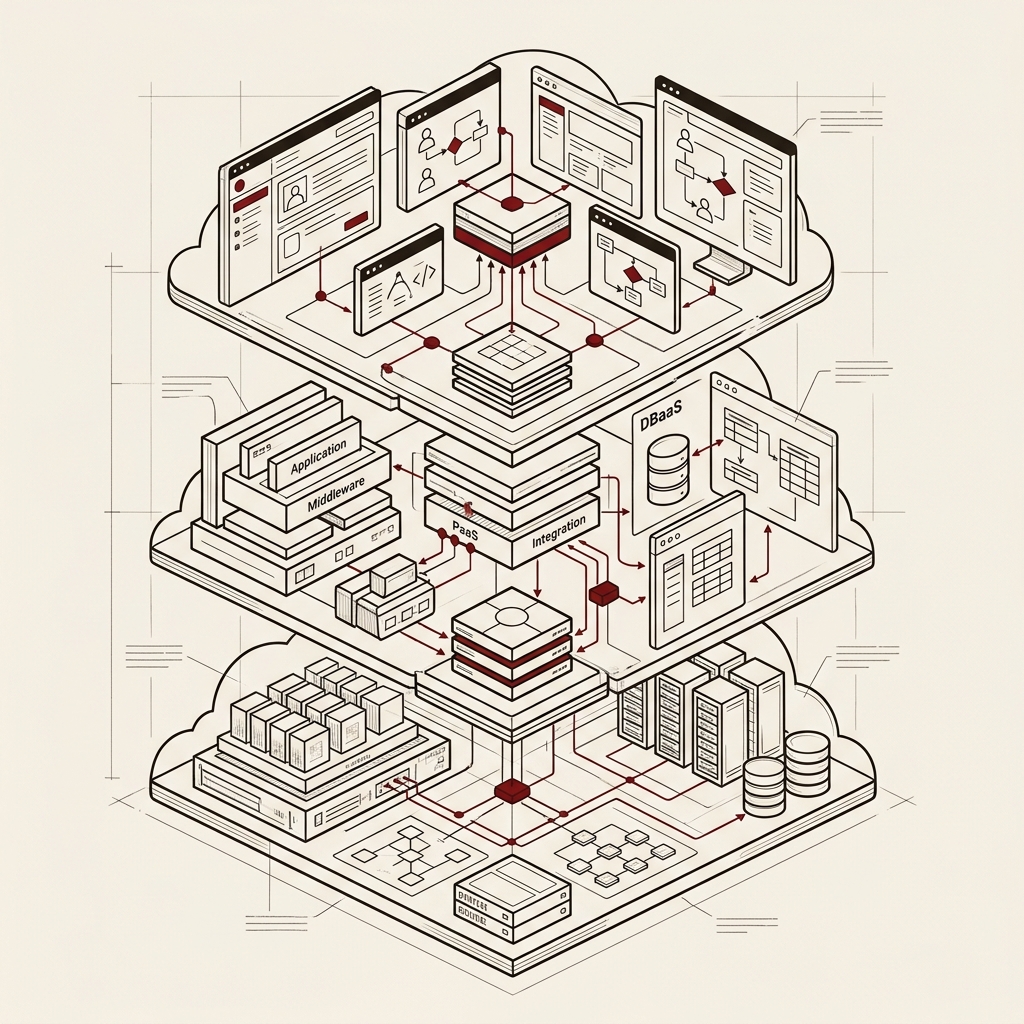
SaaS, IaaS, PaaS, and DBaaS look similar — the real difference is how much you manage yourself. Part 1 maps each model's management responsibility boundary and surveys the 2026 global cloud market with AI at the center.
Series outline
- Part 1 — Cloud Service Models and the 2026 Market Landscape (this post)
- Part 2 — SaaS · IaaS · DBaaS Deep Dive: Key Players (upcoming)
- Part 3 — Selection Guide: Which Cloud Model Is Right for You? (upcoming)
Table of Contents
- Why Cloud Service Models Matter Right Now
- Cloud Service Models at a Glance
- The 2026 Global Cloud Market
- Market Share and Growth by Model
- The 2026 Mega-Trend: AI Reshaping Cloud
- Wrapping Up — What's Next in Part 2
1. Why Cloud Service Models Matter Right Now
"Do we have to buy servers ourselves?" A few years ago that was the first question every startup founder had to answer. Not anymore. Open the AWS console, click a few times, and you have servers running anywhere in the world.
Cloud computing is no longer a "future technology." 94% of businesses worldwide already use some form of cloud service. The problem is that SaaS, IaaS, PaaS, DBaaS… the alphabet soup of terms makes it hard to figure out what you actually need.
This series exists to cut through that confusion. Part 1 covers the concepts behind each model and where the market stands in 2026.
2. Cloud Service Models at a Glance
Cloud services are categorized by what you manage yourself. The table below shows who is responsible for each layer.
| Layer | On-Premises | IaaS | PaaS | SaaS |
|---|---|---|---|---|
| Hardware | You manage | ☁️ Cloud | ☁️ Cloud | ☁️ Cloud |
| OS | You manage | You manage | ☁️ Cloud | ☁️ Cloud |
| Middleware | You manage | You manage | ☁️ Cloud | ☁️ Cloud |
| Application | You manage | You manage | You manage | ☁️ Cloud |
| Data | You manage | You manage | You manage | You manage |
DBaaS does not appear as its own column above. It is a database-specialized managed service that runs on top of IaaS or PaaS, not a parallel tier. See section 2-4 below.
2-1. IaaS — Virtualized Infrastructure
Infrastructure as a Service. The cloud vendor handles physical hardware — servers, storage, and networking — delivered over the internet. Everything above the hardware layer (OS, middleware, application) is yours to configure.
- Examples: AWS EC2, Microsoft Azure VM, Google Compute Engine
- Best for: Teams needing infrastructure control, DevOps, legacy system migration
Simple analogy: you lease the land and build whatever you want on it.
2-2. PaaS — Development Platform as a Service
Platform as a Service. The vendor manages not just hardware but also the OS, runtime, and middleware. Developers focus purely on code and data.
- Examples: Heroku, Google App Engine, AWS Elastic Beanstalk, Azure App Service
- Best for: Startups that need fast deployment, teams who want to skip infrastructure management
Simple analogy: a furnished office. Just bring your own furniture (code).
2-3. SaaS — Software as a Subscription
Software as a Service. A finished application delivered directly over the internet — no installation, no update management on your end.
- Examples: Google Workspace, Salesforce, Slack, Zoom, Notion
- Best for: Small and mid-sized businesses with limited IT resources, teams that need rapid onboarding
Simple analogy: staying at a hotel. Cleaning, maintenance, and management are all handled for you.
2-4. DBaaS — Database as a Service
Database as a Service. A specialized service that runs on top of IaaS or PaaS and automates database provisioning, backups, patching, and scaling. Tasks that once kept a DBA (Database Administrator) busy for days can now be completed in minutes.
- Examples: Amazon RDS, Google Cloud Spanner, Azure SQL Database, MongoDB Atlas, PlanetScale
- Best for: Teams without dedicated DB staff, services that need fast scale-up
Simple analogy: leasing a warehouse (DB) where the warehouse operator handles inventory management, security, and cleaning.
3. The 2026 Global Cloud Market
The numbers tell the story. Cloud is no longer optional infrastructure — it is standard infrastructure.
| Metric | Figure |
|---|---|
| Total cloud market size (2026) | USD 1.04 trillion |
| Projected market size (2031) | USD 2.65 trillion |
| CAGR (2026–2031) | 20.65% |
| Share of businesses using cloud | 94% |
| New digital workloads deployed to cloud (2026) | 90% |
Source: Mordor Intelligence (Q1 2026). These figures are research estimates and may not represent final confirmed data.
4. Market Share and Growth by Model
SaaS — Still the Undisputed Leader
SaaS captures roughly 47–52% of total cloud revenue in 2026 — the dominant segment by a wide margin. The market is worth approximately $315 billion, and the average enterprise now runs 112 SaaS applications.
- SaaS market: $315B in 2026 → projected $1.13T by 2032 (~20% CAGR)
- 86% of companies use at least 11 different SaaS vendors
- AI-enabled apps account for 40% of all enterprise applications
IaaS — The Fastest-Growing Segment
IaaS represents about 31% of total cloud spending, fueled by AI, big data, and remote-work infrastructure demand.
- Market share: AWS 32%, Microsoft Azure 23%, Google Cloud 12%
- 82% of IT decision-makers run workloads on IaaS
- Only 8% of companies rely on a single IaaS provider (multi-cloud is the norm)
DBaaS — The Quiet Powerhouse
The DBaaS market stands at $201 billion in 2026 and is projected to grow at 54.3% annually through 2035. More than 50% of organizations already use DBaaS, with 25% year-over-year growth recorded.
5. The 2026 Mega-Trend: AI Reshaping Cloud
The single most powerful keyword running through the 2026 cloud market is AI.
GenAI Is Driving Half of Cloud Growth
Generative AI technology was behind roughly half of cloud market growth in 2025–2026. AWS announced $150 billion in AI-focused data center investment, and Databricks, valued at $62 billion in late 2024, was being discussed around the $134 billion level by early 2026 — one of the clearest growth signals in the space.
Hybrid and Multi-Cloud Become the Default
The era of "all-in on one cloud" is winding down. Experts predict that from 2026 onward, hybrid and multi-cloud will be the architectural default, not a choice.
- Companies using hybrid cloud: 39%
- Companies with a multi-cloud strategy: 33%
- Regulation and data sovereignty are the primary drivers of hybrid adoption
AI Features Come With a Price
SaaS vendors are rolling out AI capabilities as separate add-ons, charging an extra $20–50 per user per month. Major vendors including Salesforce and ServiceNow are requesting 15–25% price increases at renewal.
DBaaS + AI: A Natural Pairing
Analytics and AI workloads have emerged as the core driver of DBaaS growth. As databases become the underlying infrastructure for AI model training, DBaaS is evolving from a simple storage layer into an intelligent data platform.
6. Wrapping Up — What's Next in Part 2
In 2026, the cloud services market is growing at an unprecedented pace. A market that has crossed the trillion-dollar mark is combining with AI and blurring the old model boundaries.
This part covered the big picture — concepts and market status for SaaS, IaaS, PaaS, and DBaaS. Part 2 will go deeper on the key players in each model and put DBaaS's hidden heavyweights in the spotlight.
Part 2 preview: AWS RDS vs Google Cloud Spanner vs MongoDB Atlas — who wins the DBaaS three-way?
Data as of: Q1 2026 / Sources: Mordor Intelligence, Finout, Medha Cloud, BetterCloud, DataStackHub, CloudZero
References
Use these documents when re-checking the technical claims and operational guidance in this article.