Data Engineering Playbook — Part 1: Overview & 2026 Key Trends
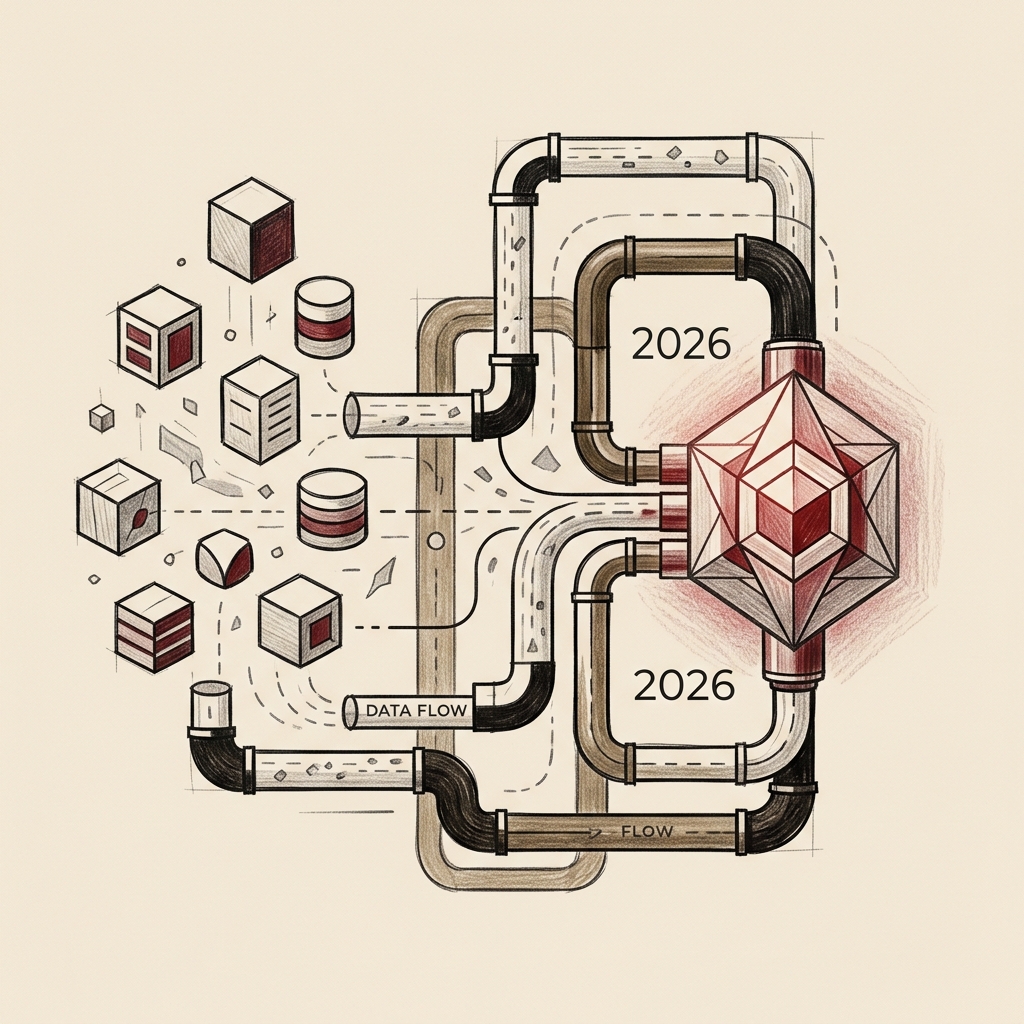
Data engineering encompasses every technical activity that collects, transforms, and stores raw data into forms consumable by analytics and AI. In 2026 the discipline has become the critical backbone of AI infrastructure, reshaped by seven converging trends: AI-Native DataOps, streaming ubiquity, Lakehouse mainstream adoption, governance-as-code, Data Mesh, FinOps, and multimodal data infrastructure. This post traces how the data engineer's role evolved from 2020 to 2026, maps the modern data stack end-to-end, and outlines the technical and soft skills required today. A self-diagnostic checklist lets you assess your team's current data maturity before diving into upcoming parts.
Series outline
- Part 1 — Overview & 2026 Key Trends (this post)
- Part 2 — Data Architecture Design (Lakehouse, Data Mesh, Lambda/Kappa) (upcoming)
- Part 3 — Building Data Pipelines (ETL/ELT, Orchestration, Streaming) (upcoming)
- Part 4 — Data Quality & Governance (DataGovOps, Observability) (upcoming)
- Part 5 — Cloud & Infrastructure (AWS/GCP/Azure, FinOps, IaC) (upcoming)
- Part 6 — AI-Native Data Engineering (AI Copilot, Feature Store, MLOps) (upcoming)
- Part 7 — DataOps & Team Operations Playbook (upcoming)
Table of contents
- What is Data Engineering?
- How the Data Engineer's Role Has Changed (2020 → 2026)
- Seven Key Trends for 2026
- The Modern Data Stack
- The Data Engineer's Skill Map
- Before You Begin: Self-Diagnostic Checklist
1. What is Data Engineering?
Data engineering refers to every technical activity involved in collecting, transforming, and storing raw data in a form that analytics workloads and AI models can consume. Put simply, it is the discipline of designing and operating "the roads and plumbing through which data flows."
[Source systems]        [Pipeline]                [Storage]           [Consumers]
 DB, API, IoT   →  Ingest · Transform    →   DW / Lakehouse  →   BI · ML · Apps
 Logs, events       Cleanse (Transform)       Data Lake            AI agents
Beyond simple pipeline construction, data engineering in 2026 has been elevated to the critical backbone of AI infrastructure. The quality of what AI delivers is ultimately bound by the quality of the data pipelines feeding it.
"Data engineering is the make-or-break factor for AI success. The companies winning with AI aren't the ones with the biggest budgets — they're the ones who got their data organized first." — Rostyslav Fedynyshyn, Head of Data & Analytics at N-iX
2. How the Data Engineer's Role Has Changed
2020 vs. 2026 comparison
| Item | 2020 | 2026 |
|---|---|---|
| Core role | Pipeline builder | Data platform architect |
| Key tools | Hadoop, Spark, Airflow | Databricks, dbt, Iceberg, Flink |
| Processing paradigm | Batch-centric | Streaming + batch unified |
| Architecture | Centralized data warehouse | Lakehouse / Data Mesh |
| Quality management | Post-hoc debugging | Quality embedded across all pipeline stages |
| Governance | Manual documentation | DataGovOps (governance-as-code) |
| AI integration | Delivering data to ML teams | Designing AI-Native pipelines directly |
| Cost awareness | Not the engineer's concern | FinOps skills required |
Job postings have shifted accordingly. Where employers once demanded "5 years of Spark experience," they now ask for "the ability to design scalable data architectures and translate business requirements into technical solutions."
3. Seven Key Trends for 2026
🔥 Trend 1. AI-Native Data Operations (AI-Driven DataOps)
AI copilots and autonomous workflows have become standard components of the data engineering toolkit. LLM-powered platforms now handle complex pipeline logic, query generation, and anomaly detection in natural language.
- Autonomous monitoring: AI watches pipelines around the clock and automatically detects anomalous data distributions
- Self-healing pipelines: When failures occur, AI diagnoses the root cause and attempts automatic remediation
- Market outlook: The autonomous data platform market is expected to grow from roughly $2.5 billion in 2025 to $15 billion by 2033 (Gartner)
- Impact: Gartner predicts AI-augmented workflows will reduce manual data management interventions by approximately 60% by 2027
📌 Practical takeaway: Don't fear the tools — treat AI as a "junior engineer." Let AI draft; let humans validate and make architecture decisions.
🔥 Trend 2. Streaming Goes Mainstream & Stream-Batch Convergence
The "should we stream?" debate is over. The question is now "how do we unify streaming and batch?"
- Apache Kafka, Apache Flink, AWS Kinesis, and Google Pub/Sub have become the standard for event-driven architectures
- Real-time analytics market: $14.5 billion in 2023, projected to exceed $35 billion by 2032
- Key use cases: fraud detection, personalized recommendations, operational analytics
Event → Kafka Topic → Flink processing → Iceberg/Delta Lake → real-time dashboard
                              ↓
                       ML feature store
🔥 Trend 3. Lakehouse Architecture Goes Mainstream
The line between data warehouses (structured data) and data lakes (unstructured data) has dissolved. The Lakehouse combines the best of both worlds.
- Lakehouse adoption is spreading rapidly among large enterprises and has become the de-facto default for new data platform builds
- Core open table formats: Apache Iceberg, Delta Lake, Apache Hudi
- ACID transactions, schema evolution, and time-travel queries are now table stakes
| Format | Strengths | Key adopters |
|---|---|---|
| Apache Iceberg | Large-scale table management, multi-engine support | AWS, Netflix, Apple |
| Delta Lake | Optimized for the Databricks ecosystem | Databricks users |
| Apache Hudi | Best-in-class streaming upserts | Uber, Amazon |
🔥 Trend 4. DataGovOps — Governance-as-Code
DataGovOps is a compound concept describing the practice of implementing data governance procedures through code and automated processes rather than manual oversight. Compliance workflows, audit trails, and data lineage tracking are all handled programmatically.
- The EU AI Act (in force since 2025) makes data governance a legal obligation, not an option
- Data quality checks are embedded throughout the pipeline — at every stage, not just at the end
- Fail fast: Transformations that produce unexpected null values are blocked before they propagate downstream
# Example: embedding quality checks with dbt tests
# models/schema.yml
models:
  - name: orders
    columns:
      - name: order_id
        tests:
          - unique
          - not_null
      - name: amount
        tests:
          - not_null
          - dbt_expectations.expect_column_values_to_be_between:
              min_value: 0
🔥 Trend 5. Data Mesh — Distributed Data Ownership
A paradigm shift designed to eliminate the bottleneck of centralized data teams. Domain teams own and manage their own data directly.
- Four core principles: domain ownership, data-as-a-product, self-serve platform, federated governance
- Key enabling tools: Trino (PrestoSQL), Databricks Lakehouse Federation, BigQuery Omni
- Reduces centralization bottlenecks while maintaining enterprise-wide data consistency
🔥 Trend 6. FinOps — Cost as a First-Class Citizen
As cloud costs spiraled out of control, data engineers became accountable for spend.
- Choose storage tiers intentionally, not by default
- Right-size and schedule compute resources appropriately
- Cost attribution tooling by pipeline and team is proliferating
- Eliminate unnecessary transformations through query pattern analysis
🔥 Trend 7. Multimodal Data Infrastructure
Data is no longer just numbers and text tables. Images, audio, video, and sensor streams are now all in scope.
- Data engineers must now design pipelines capable of handling unstructured data
- Integrating vector databases (Pinecone, Weaviate, pgvector) has become routine
- Building context engineering infrastructure for AI agents is an emerging responsibility
4. The Modern Data Stack
5. The Data Engineer's Skill Map
🏗️ Technical Skills
| Category | Core skills | Advanced skills |
|---|---|---|
| Programming | Python, SQL | Scala, Go |
| Batch processing | Spark, dbt | Trino, DuckDB |
| Stream processing | Kafka | Flink, Spark Streaming |
| Cloud | AWS, GCP, or Azure (at least one) | Multi-cloud strategy |
| Orchestration | Airflow | Dagster, Prefect |
| Data formats | Parquet, Avro | Iceberg, Delta Lake |
| Containers | Docker | Kubernetes |
| IaC | Terraform basics | Advanced module design |
🧠 Soft Skills
- Business translation: Converting domain problems into pipeline designs
- Cost sensibility: Evaluating architecture decisions through a cost lens
- Data contract negotiation: Agreeing on SLAs with upstream and downstream teams
- Documentation habits: Maintaining data catalogs, READMEs, and changelogs
6. Before You Begin: Self-Diagnostic Checklist
Check your team's current state before reading the next parts.
Architecture
- Are the roles of your data warehouse and data lake clearly defined?
- Have you evaluated adopting an open table format (Iceberg/Delta)?
- Is data ownership defined per domain?
Pipelines
- Do your pipelines include automated quality checks?
- Are alerting and retry policies defined for failed pipelines?
- Are batch and streaming processing designed as an integrated whole?
Governance
- Is your data catalog kept up to date?
- Can you trace data lineage end-to-end?
- Are masking and access controls in place for PII data?
Operations
- Can you measure cost per pipeline?
- Are SLAs defined for processing latency and data freshness?
- Are on-call processes and runbooks ready?
If fewer than half the boxes are checked, work through Part 2 (architecture) and Part 3 (pipeline construction) in order. Teams in better shape can jump to whichever part addresses their weakest area — Part 4 (governance), Part 5 (cloud and cost), or Part 6 (AI-Native).
Closing
In 2026, data engineering is no longer just "moving data around." It has entered the domain of strategic infrastructure design — the factor that determines an organization's AI competitiveness. From building pipelines to designing platforms, optimizing costs, and implementing governance as code, the data engineer's reach has never been wider.
Part 2 takes a deep dive into real-world architecture design: Lakehouse, Data Mesh, and the Lambda vs. Kappa architecture choice.
Written: April 2026 | References: Binariks, KDnuggets, Monte Carlo Data, lakeFS, N-iX
References
Use these documents when re-checking the technical claims and operational guidance in this article.