DA? DBA? DBE? — Part 4: Survival Strategies in the Age of AI and Cloud
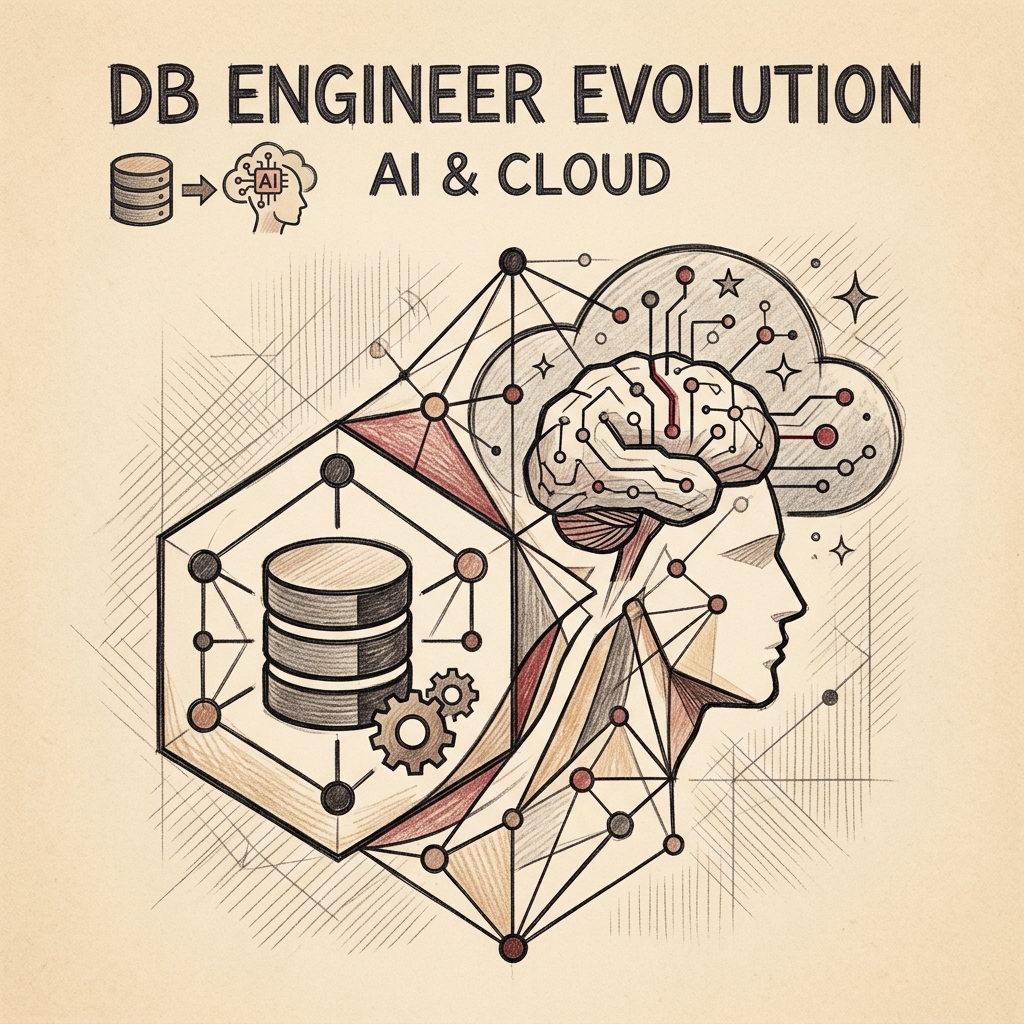
Cloud-managed services like AWS RDS, Aurora, and Oracle Autonomous Database now handle patching, backups, and failover automatically — making the question of whether DA, DBA, and DBE roles will be replaced by AI feel very real. Studies estimate automation risk at around 35%, suggesting AI will augment these roles rather than eliminate them. Areas like business-context judgment, complex incident diagnosis, and strategic architecture design are proving to be exactly where human expertise holds its value. This final part maps how DA evolves into a data governance designer, DBA into a Data Platform Engineer (DBRE), and DBE into an AI data infrastructure architect — and closes with a role-by-role survival checklist.
Series Overview
- Part 1 — Concepts: What Do DA, DBA, and DBE Actually Do?
- Part 2 — Real-World Comparison: How They Differ in Practice
- Part 3 — Career Roadmap: How to Get Started and How Far Can You Go?
- Part 4 — Survival Strategies in the Age of AI and Cloud (current)
Table of Contents
- Introduction
- What AI and Cloud Are Actually Replacing
- So Is AI Replacing DBAs?
- Areas AI Cannot Take — This Is Where the Future Lives
- How the Roles Are Evolving: Where Are DA, DBA, and DBE Headed?
- What Survivors Have in Common
- 2026 Survival Checklist for Data Roles
- Closing — Full Series Summary
1. Introduction
April 2026, right now.
AWS RDS handles patches, backups, and failover without human intervention.
Oracle Autonomous Database tunes itself, patches itself, and applies its own security updates.
AI-powered monitoring tools detect slow queries, suggest index changes, and sometimes apply them directly.
So a natural question follows:
"DA, DBA, DBE… are these people even necessary anymore?"
Here's the conclusion upfront.
What disappears is "part of the role." What remains is "harder work."
2. What AI and Cloud Are Actually Replacing
First, let's be honest. AI and cloud automation are genuinely taking over a significant portion of DBA work.
The biggest shift for DBAs isn't actually AI itself — it's the migration to cloud-managed database services. Services like AWS RDS, Azure SQL, and Google Cloud SQL handle patching, backups, failover, and basic performance tuning automatically. Oracle Autonomous Database goes a step further: it tunes itself, patches itself, and applies its own security.
According to Oracle, Autonomous Database uses AI and machine learning to provide complete end-to-end automation for provisioning, security, updates, availability, performance, change management, and error prevention.
And this announcement carries a telling follow-up:
"DBAs can now focus on more important work — data aggregation, modeling, processing, and governance strategy."
"More important work" — in other words, the space left by AI is being filled by harder, more judgment-intensive responsibilities.
3. So Is AI Replacing DBAs?
Studies analyzing AI exposure and automation risk suggest the answer is: not yet.
One analysis estimates AI exposure at around 48% for the DBA role, with automation risk at 35%. The key point is the classification as an "Augmentation" automation mode — AI is expected to enhance the role, not eliminate it.
The relatively low automation risk (35%) reflects the fact that DBA work involves critical systems where failures have severe consequences. Organizations are cautious about fully automating the management of their most important asset: data.
This matters. The reluctance to hand over data management 100% to AI isn't simple conservatism. The consequences of getting it wrong are too severe. A bad backup, a botched migration, a failed recovery — any of these can bring an entire business to a halt. That accountability still belongs to humans.
4. Areas AI Cannot Take — This Is Where the Future Lives
There are areas AI struggles to automate or simply cannot yet handle.
🧠 Business-Context Judgment
Understanding a business plan like "this service might see 10× traffic in three months" and deciding how the database architecture needs to change today. AI can analyze numbers, but interpreting business intent and translating it into data structure is still a human domain.
🔍 Complex Incident Tracing and Root Cause Analysis
Even when AI monitoring catches anomalies, tracing the root cause of multi-system compound failures and designing prevention structures still requires deep experience. Diagnosing complex performance issues spanning application code, query design, and infrastructure is something AI can assist with — but the final call belongs to a person.
🏗️ Strategic Architecture Design
Choosing between relational, document, graph, and time-series databases for a specific use case requires a deep understanding of business requirements. Explaining and making the case for "why this database" goes well beyond pure technical knowledge.
🔐 Data Governance and Compliance
Responding to GDPR, PIPA (Korea's Personal Information Protection Act), and financial regulations requires more than technical knowledge. It takes someone who understands both the legal context and the business risks.
🤝 Cross-Organizational Coordination and Guidance
DBAs need to focus on data itself rather than just database management, and act as a bridge between developers and business users. Providing insight into how systems behave under varying conditions is one of the hardest areas for AI to replicate.
5. How the Roles Are Evolving: Where Are DA, DBA, and DBE Headed?
DA: Data Modeler → Data Governance Designer
As AI generates data at explosive scale, demand for "how do we define and govern this data" is actually growing. The DA role is expanding from simple ERD creation toward designing the architecture of an entire data platform.
- AI training data quality design — Designing schemas and classification systems for AI model training data
- Data Contract management — Documenting explicit agreements between data producers and consumers within the organization
- Metadata platform development — Operating data catalogs using tools like DataHub and Apache Atlas
DBA: Database Administrator → Data Platform Engineer (DBRE)
The view that the title "DBA" no longer fully captures what these professionals do is gaining traction. The "new role" taking shape is the Data Platform Engineer or DBRE (Database Reliability Engineer).
DBRE applies the philosophy of SRE (Site Reliability Engineering) to databases. The paradigm shifts from "keep the DB from breaking" to "manage the DB system itself as code and automate it."
Existing DBA skills
  + IaC (Infrastructure as Code): Terraform, Pulumi
  + GitOps-based DB change management: Flyway, Liquibase
  + Cloud-native DB operations: Aurora, AlloyDB, Cosmos DB
  + Observability: Prometheus + Grafana + OpenTelemetry
  + Python automation scripting
= DBRE / Data Platform Engineer
DBE: DB Tooling Developer → AI Data Infrastructure Architect
As AI agents that reason and act autonomously are rapidly entering the field, a new domain opens for DBEs: designing and building the data infrastructure that AI systems need.
- Vector database design: pgvector, Pinecone, Weaviate — core infrastructure for LLM-based services
- Real-time streaming pipelines: Kafka + Flink-based data flow design
- Feature Store development: Data pipelines for ML model training and serving
- Data Mesh architecture: Distributed data platform design at organizational scale
6. What Survivors Have in Common
In 2026, data professionals whose market value is rising share common patterns.
① Become someone who knows AI's limits
Knowing when AI is wrong is just as important as being good at using AI tools. When an automatic index optimization suggestion misreads actual workload patterns, when AI monitoring misses an unusual failure pattern — this ability comes from a deep understanding of how databases work internally.
② Use "cloud + code" together
The shift is from DBAs who only use CLIs and consoles to engineers who define infrastructure as code and design automation systems. As AI copilots take over repetitive tasks, engineers are expected to focus on prompt design, intent verification, and operating large-scale automation.
③ Understand the "business," not just the "data"
As automation deepens, the roles that survive are those at the intersection of technology and business judgment. The gap in value between someone who thinks "what business requirements will this structure need to accommodate down the line?" and someone who just creates a table is growing wider every year.
④ Build one area of deep expertise
Multi-DBMS breadth matters, but having a domain where colleagues say "you need to ask them about this" is a long-term advantage.
- Large-scale Oracle environments in financial services
- NoSQL + distributed systems architecture
- Vector DB and Feature Store for AI/ML infrastructure
- Cloud-native database migration
7. 2026 Survival Checklist for Data Roles
Check your current skills. If many boxes are empty, that's your next learning direction.
DA Checklist
- Can you handle conceptual, logical, and physical modeling end to end?
- Can you document data standards and persuade the organization to adopt them?
- Can you work with data catalog tools like DataHub or Apache Atlas?
- Do you understand GDPR, PIPA, and other data regulations well enough to reflect them in design?
- Have you designed schemas for AI model training data?
DBA Checklist
- Can you explain the internal architecture of your primary DBMS (query optimizer, buffer pool, transaction engine)?
- Have you operated cloud-managed databases like RDS, Aurora, or Cloud SQL in production?
- Can you write automation scripts in Python or Bash?
- Have you built a monitoring stack using Prometheus + Grafana from scratch?
- Have you managed DB infrastructure as code using IaC tools like Terraform?
DBE Checklist
- Have you applied sharding, replication, and partitioning strategies in a real service?
- Have you designed streaming data pipelines using Kafka, Flink, or similar tools?
- Do you have experience building AI service infrastructure using vector databases like pgvector or Pinecone?
- Have you used database migration tools like Flyway or Liquibase in production?
- Have you applied CAP theorem reasoning to actual design decisions in a distributed system?
8. Closing — Full Series Summary
Four parts. Three roles dissected.
Part 1 established the definitions of DA, DBA, and DBE. Part 2 examined the realities and tensions of real-world practice. Part 3 mapped concrete entry paths and salary data. And this final Part 4 explored where these roles are heading in the age of AI and cloud.
The message this series set out to deliver is a single one:
Data roles are not being replaced by AI. They are evolving into roles that solve harder problems alongside AI.
The routine work that automation has taken away is being replaced by deeper judgment and broader contextual understanding.
The people who claim that space will be the ones who thrive going forward.
References
- Will AI Replace Database Administrators? 2026 Analysis — AI Changing Work
- What Is Autonomous Database? — Oracle Korea
- Oracle AI Database — Oracle Korea
- How Autonomous DB Changes the DBA Role — Solaris Blog
- "DBAs Are Disappearing" — Future Roles for Database Professionals — ITWorld
- 2026 Data Centers: AI Reshaping Operations — TechWorld News
- 2026 AI Trends: Agentic AI — Hancom Tech
- [Column] Can SRE Replace the DBA? — GTT Korea
- The Database Professional Landscape from a DBA's Perspective — RastaLion.dev
References
Use these documents when re-checking the technical claims and operational guidance in this article.